Photographing Herself into the Canon - Nan Goldin
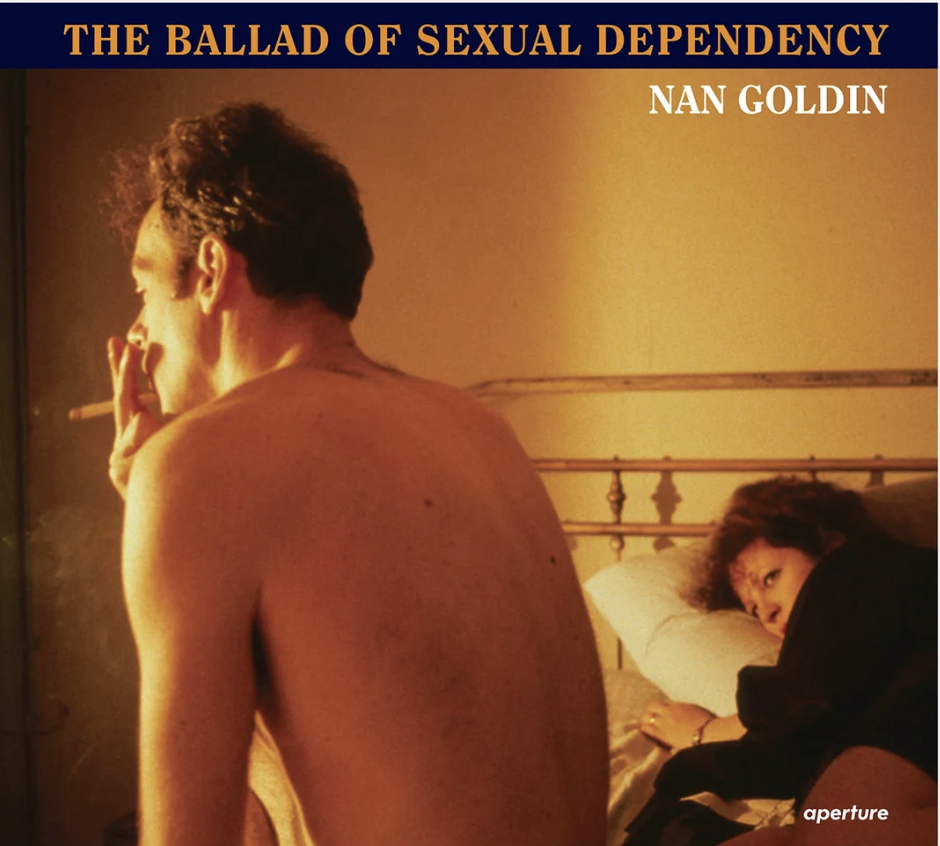
Book cover of Nan Goldin “The Balld of Sexual Dependency” sold by aperture
In the current political climate, the debate around the objectification and corrosive step to the commodification of women’s bodies rages on. Through the radical creative practice of self-portraiture, an army of women artists is reclaiming their own form by serving as both photographers and muses. Each takes the practice of self-portraits into a different realm of style. To start this series, I will talk about Nan Goldin.
Nan Goldin, American, born 1953. Goldin uses her camera to document the raw and vulnerable parts of her life and the lives of those around her. There is an intimate understanding of her body of work, as a major portion of her career was defined by activism within her community, first in the late 80s around the AIDS crisis, then in 2017 around the opioid crisis.
The layers of depth in Goldin's work go beyond realism; they are reality. They are raw, unfiltered, and filled with complex but relatable emotion. Goldin’s The Ballad of Sexual Dependency is one of her most prevalent and referenced works, filled with self-portraits portraying her lived experiences in the late 70s, 80s, and beyond. It is, as Glodin states, “the diary I let people read”. The title of the project, The Ballad of Sexual Dependency, addresses the psychological influence of codependency, the role of sex as a love scale, and the violence that shatters the rose-colored glasses of relationships. The work comprises over 700 images and was originally designed as an installation, later published as a photobook. It has been shown more recently at many notable venues, including the Museum of Modern Art, the Whitney, and the Museum of Contemporary Art in Los Angeles. The work, in its original form, was shown in underground venues, avant-garde cinemas, and downtown New York clubs.
Goldin's work documents the authenticity of life lived in all its ugly, disjointed nature. But it attempts to humanize the experience of living as true to oneself. That is where the beauty lies. So much of the art world is about capturing “beauty” and placing it on a pedestal for all to validate its beauty. But Goldin takes that and inverts it to reflect the honest and complex elements of navigating the world. Her work follows the pattern of a visual ballad, hence the genuineness of the title The Ballad of Sexual Dependency. And although that title is for a specific body of her work, the concept of a “Ballad” as a methodology is consistent throughout her practice. The formula of a ballad follows that of a tale of sorts, with repetitive elements. In the body of work we see, through a progression of snapshots, a visual vocabulary of the behaviors and lives of those she photographed.

In addition to her better-known work, Goldin consistently used self-portraiture as a recurring element in her practice. What’s interesting to note is that her image is, more often than not, out of focus or off-center. With a few exceptions, such as “Nan One Month After Being Battered,” 1984. In this shift in compositional choice, Goldin confronts the camera and the viewer with the pain and aftermath of domestic violence. Calling clear and direct attention to what domestic violence looks like.

Nan One Month After Being Battered, 1984
Silver dye bleach print
15 1/2 × 23 1/8 in | 39.4 × 58.7 cm
Goldin is a prime player in the heroines’ chic identity. Utilizing the medium of photography to document life in all of its multidimensional facets. She herself, as a subject, is one of the strongest elements of her work; it is unpolished and more direct than much of the work circulating at the height of her career. With Goldin’s work, it is best to expect the unexpected, be prepared for shock and unconventional subject matter. In addition to seeing the vivid reality of a world beneath the conventional understanding of beauty, immortalized.